Most small business owners didn’t choose their bank. They defaulted to it — a familiar name, a nearby branch, whatever their accountant suggested when they were just getting started. And then they stayed, even as the business grew, even as the friction mounted, even as better options emerged.
That inertia has a cost. Not always a visible one — but a real one, measured in time spent on unnecessary processes, in loan decisions that took weeks when they should have taken hours, and in a banking relationship that was designed around the institution’s convenience rather than the business owner’s.
Mike Butler has watched this pattern repeat across decades in banking: first at large institutions, then at the community bank level, and now as CEO of Grasshopper, a federally chartered, FDIC-insured digital bank built to serve the businesses and the innovation economy. His perspective on what’s broken in small business banking — and what genuinely works — offer us a useful lens whether you’re evaluating your first business bank account or reassessing one you’ve had for years.
Want to hear it straight from the source? Listen to the full conversation with Loren Feldman and Mike Butler on the 21 Hats podcast.
The Core Problem: Small Business Owners Don’t Have Time
Mike Butler shaped his entire approach to leading Grasshopper around a deceptively simple insight. Small businesses don’t have a chief financial officer (CFO). They don’t have a chief marketing officer (CMO) or a chief technology officer (CTO). The owner does everything, and time is the one resource they can never get back.
Traditional banking wasn’t designed with that reality in mind. Branch hours that assume you can leave your business mid-afternoon. Loan applications that ask you to gather documents you’ve already submitted elsewhere. Account opening processes that take a week when they should take minutes. Support lines that put you on hold for twenty minutes to answer a question that should take two. Every one of those friction points extracts time from a business owner who has none to spare, and it compounds across every interaction, every month, for as long as you stay at that bank.
Grasshopper’s response to that reality was to rebuild the experience from scratch, not to digitize the traditional banking process, but to replace it with something designed around how small businesses actually operate. The result is an account opening experience that takes as little as five minutes from any device, no paper or branch visit required. That’s not a minor convenience improvement. For a business owner who has been told to come back next week, it’s a pivotal moment where banking starts to feel aligned with how they actually run their business.
What this means for your business: If your current banking experience regularly asks you to wait — for approvals, for support, for answers — that wait has a dollar value. Time spent on banking administration is time not spent on the business. The right banking partner eliminates that trade-off rather than normalizing it.
The Approach: What “Client First” Actually Means in Practice
Branch banking operates on a specific logic: the bank sets the hours, the bank sets the process, and the client fits around it. Come in between 9 and 3. Wait in the queue. Fill out the paperwork. Call back if you have questions. Butler describes that model plainly as business first, not client.
Client first means the bank adapts to how you work, not the other way around. It means answers come quickly, because a business owner who needs to know whether they qualify for a loan shouldn’t have to wait a month to hear no. It means support is available through the channel that works for you — phone, chat, email, secure message — not just during branch hours. It means the technology works well enough that banking stops being something you have to think about and becomes infrastructure that runs quietly in the background while you focus on the business.
The practical test Butler suggests is straightforward: when you go to a bank’s website, does it prominently address small businesses? Are there real digital tools available, or is the digital presence a veneer over a branch-dependent process? Does the bank communicate that it understands time is your most limited resource — or does it ask you to wait in line, call back later, or come in next week?
Those signals show up early. And more often than not, they tell you exactly what kind of banking relationship you’re stepping into.
What this means for your business: Before your next account review, spend ten minutes on your bank’s website as if you were a new customer. If the experience doesn’t clearly demonstrate that small businesses are a priority — in the tools offered, the language used, and the processes described — that’s a meaningful signal it may be time to reconsider your banking relationship.
The Reality of Loan Applications And What’s Actually Possible
The loan application process at traditional banks is one of the most consistent frustrations small business owners have. Not just that it’s slow, but that the slowness feels dishonest. Business owners often suspect the bank knew early in the process whether the loan would be approved, but kept them waiting through weeks of paperwork and follow-up requests anyway.
That frustration is legitimate, and the root cause is structural. Traditional lending processes were built around paper documentation: tax returns, bank statements, financial projections assembled manually and reviewed sequentially. The process takes as long as it does not because the credit decision is genuinely complex, but because the infrastructure for making it efficiently was never built.
Digital data changes that equation entirely. Grasshopper uses modern data sources and AI-driven scorecards to make credit decisions with significantly less friction, understanding what business a client is in, assessing their financial position, and evaluating creditworthiness without requiring them to manually supply information that already exists. The result is a lending experience that answers the question most business owners actually want answered, “Can I get this loan or not?” in 5-10x faster than standard industry, approval timelines.
SBA loans, which have historically been among the most document-intensive lending processes available, have been rebuilt at Grasshopper to work the same way. As an SBA preferred lender, the guidelines and credit standards remain the same, but the experience is fundamentally different: a streamlined, front-end application designed to gather the right information upfront and move qualified borrowers through the process as quickly as possible.
What this means for your business: If you’re anticipating a capital need in the next 6 to 12 months, start exploring financing now when your finances are strong and you have time to evaluate your options rather than accepting whatever is available under deadline pressure. Ask your bank specifically: how quickly can I get a clear yes or no and what would prevent me from getting a decision quickly?
Knowing When to Take a Loan and When Not to
Access to capital is more available today than at any point in the past due to the emergence of digital lenders, AI-driven underwriting, and non-bank financing options has meaningfully expanded what’s accessible to small businesses. Butler sees that as unambiguously good for the market.
But expanded access comes with a responsibility that ultimately rests with the borrower. Butler is direct about this: a lender can provide good information and useful tools, but the decision to borrow belongs to the business owner. Taking on debt that doesn’t make financial sense for the business — regardless of how accessible or quickly approved it is — is a borrower decision, not a lender one.
The question worth asking before any borrowing decision is straightforward: will the use of these funds generate a return that justifies the cost of the capital? A short-term loan that finances inventory leading to a profitable sale is a good deal even if the reported APR may seem high because the business gained more than it paid. A loan taken under financial stress to cover obligations that the business can’t sustain creates a spiral that faster approval only accelerates.
Small businesses should look out for lenders that provide tools on its website to educate and help business owners make an informed decision. Lenders that invest in resources like a blog, help center or similar channels that help a potential customer evaluate whether borrowing is the right move and support a decision not to borrow demonstrates what client-first actually looks like in practice.
What this means for your business: Before applying for any loan, run a simple test: map the specific use of funds to a specific financial outcome, and estimate whether the return on that outcome exceeds the cost of the capital. If the economics are favorable, it’s likely a good decision. If it depends on optimistic projections to justify the cost, it’s worth waiting for the right conditions.
What You Actually Lose When You Leave a Traditional Bank
One of the most common pieces of advice given to small business owners is to build a personal relationship with a local banker, especially if they expect to need financing. The implicit assumption is that a human relationship, built over time, is what makes a bank willing to work with you when things get complicated.
Butler doesn’t dismiss that value. He reframes it.
The local banker relationship has a well-documented failure mode: change. The bank gets acquired. Leadership or priorities shift. The relationship you spent years building evaporates overnight, and you’re starting over with someone who doesn’t know your business and doesn’t owe you anything. Butler has watched this happen repeatedly across decades in the industry. It’s not the existence of change, but a reflection of how often continuity is lost when it happens..
What Grasshopper offers instead is a data-informed relationship: one where the bank knows your business not because you’ve had lunch together, but because it has genuine visibility into how you transact, how you manage cash, and how your business performs over time. That visibility is, in practice, more durable than a personal relationship with an individual who might not be there next year.
For business owners who do want human contact — and about 15% of new Grasshopper clients request it — that option exists. After account opening, clients are offered the choice to speak with an onboarding specialist, get a walkthrough of the platform, and ask questions. It’s an offer, not a requirement. Human support is available when it’s needed, not gated behind a branch visit or a hold queue.
What this means for your business: If your current banking relationship depends primarily on a specific person rather than on the institution’s systems, tools, and processes, assess what would happen if that person left. If the answer is that you’d be starting over, that relationship is less durable than it appears.
Grasshopper’s Approach to AI
Our approach to AI is deliberate and grounded. Butler describes it as starting from the inside out: first building a culture where every employee knows how to use AI in their daily work, then extending those capabilities toward client-facing tools.
The internal metric he tracks: 90% of Grasshopper employees use AI daily. That’s not a technology adoption statistic — it’s a culture indicator. It means the tools that improve speed, reduce errors, and surface better information are embedded in how the bank actually operates, not just available in theory. The practical result for clients is a bank that moves faster, makes fewer errors, and improves continuously rather than requiring periodic manual upgrades to legacy processes.
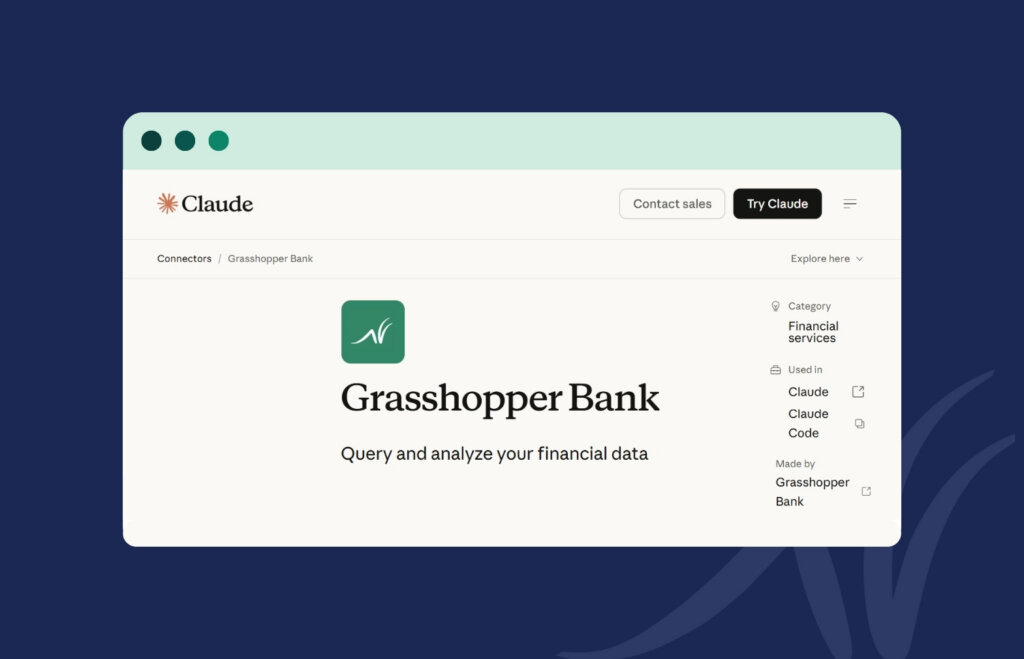
The most recent client-facing expression of that culture is the launch of our MCP-based AI connector, allowing business banking clients to leverage AI safely and securely and at scale by asking natural language questions about their finances. Who are my largest accounts payable? Have I received a payment from this vendor? What transactions hit the account last week? Questions that used to require scrolling through and exporting statements can now be answered in seconds through a conversational interface connected directly to the account.
The implications for business owners are practical and immediate. Financial visibility that previously required a bookkeeper, an accountant, or significant manual effort is now accessible on demand. The business owner who wants to quickly understand their cash position, identify their largest outstanding payables, or verify that a specific payment was received can do so in seconds through an integrated AI experience, without switching between systems.
The near-term extension of this capability is in lending, using AI to reduce turnaround times on larger, more complex loan applications that take longer to process. For loans in the $3 to $4 million range, the documentation and review process is significantly more complex than smaller term loans. Applying the same AI-driven efficiency that has shortened small loan decisions to larger transactions is the next frontier we are actively building toward.
Butler’s framing for AI adoption is worth taking seriously beyond the banking context: AI won’t take your job, but someone who knows how to use AI will. That’s not a warning. It’s a practical shift that’s already underway and one that applies as directly to small business owners as it does to banks.
What this means for your business: If you’re not yet using AI tools in your daily operations — for financial visibility, administrative work, or decision support — the gap between your productivity and that of a competitor will widen over time. The same principle that Butler applies internally at Grasshopper applies to every small business: start using the tools, overcome the learning curve, and let the efficiency compound.
The Future of Small Business Banking
Butler is measured about predictions. Five years is a long time in a technology environment moving as fast as this one, but the direction he sees is clear. More companies will build the way Grasshopper has built, embracing digital infrastructure, leveraging AI in client-facing products, and competing on the quality of the experience rather than the density of their branch network. That’s good for small businesses because it expands choices and raises the standard that every banking institution has to meet.
Credit decisions will get faster and extend to larger transaction sizes. The AI-driven efficiency that currently applies to smaller term loans will reach larger, more complex applications, reducing the friction that has historically made big financing decisions slow regardless of how strong the borrower’s profile was. Customer service will be transformed by AI in ways that make it more useful rather than less human. The ability to have a conversation with a support system that has complete, real-time knowledge of your account — and can answer specific questions about your specific transactions — is a fundamentally better experience than the current model of hold queues and generalist representatives who may or may not have access to your account history.
The thread running through all of it is the same principle Butler has applied at Grasshopper from the start: the client’s time is the scarce resource, and every product, process, and technology decision should be evaluated against whether it respects that reality or ignores it.
Questions to Ask Your Bank Right Now
Based on Butler’s perspective, here are the questions every small business owner should be able to answer about their current banking relationship:
On time and friction:
- How long does it take to get a loan decision — and will you tell me no quickly if the answer is no?
- Can I complete every routine banking task from my phone without a branch visit or phone call?
- When I have a problem, how quickly does it get resolved, and through what channels?
On technology and integration:
- Does my bank account connect directly with my accounting software and payroll platform in real time?
- Does my bank use AI tools that give me better visibility into my own account and finances?
- Is the bank’s technology built for how businesses operate today, or retrofitted onto infrastructure from decades ago?
On the relationship:
- Does my bank understand my industry and my business model?
- If my primary contact left tomorrow, would the relationship survive?
- Does my bank have the data visibility into my business to advocate for me when I need financing?
On lending:
- Does my bank originate its own loans, and does my account history factor into credit decisions?
- What are the actual rates on the lending products available to me — and how do they compare to bank-rate alternatives?
- Are there tools available to help me evaluate whether a specific borrowing decision makes financial sense?
If the answers to more than a few of these questions are unclear, incomplete, or unsatisfying, that’s meaningful information about whether your current banking relationship is actually working for your business.
The Bottom Line
Small business banking is changing. The version that asked you to rearrange your schedule around branch hours, wait weeks for a loan decision, and manage your finances through manual exports and paper statements is giving way to something faster, more transparent, and more genuinely useful.
That change doesn’t happen by accident. It happens when a bank decides that client first isn’t a tagline — it’s the operating principle that every product, process, and technology decision gets measured against.
The right banking partner for a small business isn’t necessarily the biggest one, the most familiar one, or the one with the most branches. It’s the one that was built to serve the way you actually work with the tools, the culture, and the technology to prove it.
If your bank isn’t built for how you run your business, it’s worth finding one that is. Leap on over to Grasshopper.
Listen to the full conversation with Mike Butler and Loren Feldman on the 21 Hats Podcast.