General Market Conditions
What were the biggest takeaways from the banking industry in 2025, and how can the industry leverage these learnings going into the new year?
- I would highlight two key takeaways. First, AI is real. You need a clear strategy, and data will be critical. “Make it, don’t fake it.” Use it. Second, regulatory relief is real, but it requires discipline. Be smart and remember that what the government gives, it can also take away. Self-policing will be essential. — Mike Butler, President & CEO
- In 2025, the banking industry continued its focus on digital transformation, but a key takeaway is that the industry as a whole has struggled to meaningfully adopt AI. While implementing AI to streamline operations and reduce costs has been a strategic priority, many have found it challenging to move from theory to impactful practice. Beyond the AI story, other key developments included the growing importance of Banking-as-a-Service (BaaS) and a concentrated focus on reducing fraud and operational losses. — Pete Chapman, Chief Technology Officer
- The biggest takeaway from 2025 was the industry’s realization that innovation and compliance are two sides of the same coin. The lesson specifically for embedded finance and BaaS was the necessity of truly integrated governance and risk management. Going into 2026, the primary leverage point will be using technology to enhance regulatory compliance management. Banks that invested in robust ReghTech, AI governance, and automated oversight in recent years are now positioned to scale with a compliance infrastructure ready for growth, gaining a significant competitive edge over those still playing catch-up. — Jason Boova, Chief Compliance Officer
- Reduced regulation and increased AI – both of which will take some time to reveal their true impact. — Steve Kerr, Chief Credit Officer
- In 2025, the industry moved from theoretical hype to operational reality. The “growth-at-all-costs” mindset in startups died, replaced by a focus on unit economics. In banking, the regulatory crackdown on “loose” Banking-as-a-Service (BaaS) models proved that speed without compliance is a liability. In 2026, the winners will use the efficiency gains from 2025 (AI, automation) to attack the market while others are still defensive. For Grasshopper, this means leveraging tech not just to cut costs but to strengthen compliance oversight & fraud detection, accelerate new loan originations and deposit gathering strategies, improve portfolio management with an eye towards robust trend analyses and leveraging our modern data lake to continuously improve. — Barbara Flemming, Head of Fund & Sponsor Banking
- The banking industry generally refocused on fundamentals, moving past liquidity concerns to strive for deposit and loan growth. The key takeaway, however, is the accelerating power of digital technologies, particularly AI, to revolutionize customer service. Tech-forward banks invested in and implemented AI across their organizations, discovering its incredible potential to deepen customer connections and enable more intelligent service delivery. — Dawn Gillette, Head of Digital Lending
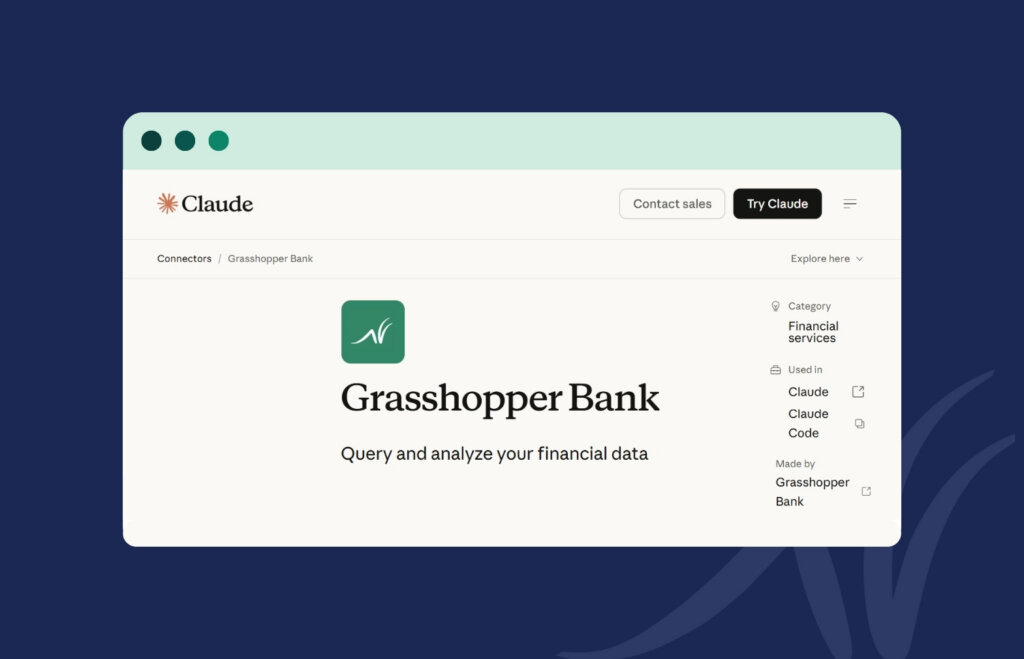
- One key trend in banking across 2025 was the ongoing integration of AI, particularly in expansive, agentic uses. While AI chatbots have been common in the industry for years, 2025 saw AI embraced in new, more comprehensive ways. One example that hits close to home: At Grasshopper Bank, we’ve integrated Anthropic’s Claude with our business banking accounts, providing small business account holders with an entirely new way to interface with–and extract value from–their bank accounts. Additionally, the Trump administration’s ongoing deregulation efforts will continue to shape banking in 2026, as will lenders’ potentially increasing stringency in the face of challenging economic conditions (outside of the AI boom). — Brennan Quenneville, Head of SBA Lending
- The industry learned that “lazy deposits” are extinct; corporate treasurers now aggressively move idle cash in response to yield variances. To leverage this in 2026, banks must learn to treat deposit yield as a utility, not a perk. Banks should build products that provide more options for customers to increase yield on operating cash and high-yield treasury instruments (like MMFs) to prevent attrition to fintechs. — Luther Liang, SVP & Head of Product
- In 2025, AI ceased being just a back-office tool focused on cost reduction and fraud detection. The real game-changer was its evolution into a front-office intelligence layer. Our competitive advantage now hinges not on simply possessing AI capabilities, but on how effectively we use that intelligence to deliver truly hyper-personalized and proactive advice directly into the hands of our small business clients. Small business owners have grown frustrated with silo’d systems and outdated technologies. Banking products even more than ever need to deliver truly seamless digital experiences and frictionless integrations. The gap for digital experience is widening and will become even more apparent with AI-powered integrations. The rise of Embedded Finance and Banking-as-a-Service (BaaS) confirms a non-negotiable truth: our bank must evolve from an external vendor to an integrated partner. Banking services must be delivered directly within the small business’s operational flow—their accounting software, their payroll providers, and their vertical-specific platforms. This is how we maintain primacy of the relationship and ensure our products are available at the precise moment of need, not when they remember to log into our separate portal. — Danielle Kane, SVP & Head of Small Business Banking
What trends do you expect will most significantly impact the banking industry in 2026, and which might have the most staying power beyond next year?
- Stablecoin for payments is a potential game changer. — Mike Butler, President & CEO
- The most significant trend for 2026—and the one with the most staying power—will be the activation of data. This goes far beyond just customer-facing features. The real revolution will happen inside the bank. We’ll see a major push to empower employees with AI-driven tools, like our internal Hopper (Gemini Enterprise), to make them faster and more effective. Furthermore, the ability to develop and deploy homegrown automation agents on the back end will separate the leaders from the laggards. While others are still figuring out their data, we’ll be using ours to drive massive operational efficiencies from within. — Pete Chapman, Chief Technology Officer
- In 2026, the two most significant trends will be the rise of Agentic AI and the mainstream adoption of Real-Time Payments (RTP) infrastructure. Agentic AI will move beyond chatbots and basic prompts to autonomous systems that perform complex tasks, like preemptively rebalancing a client’s portfolio or executing tailored, real-time fraud defense. Agentic AI will help drive hyper-personalization and compliance effectiveness at scale. The shift toward tokenization and programmable money will have the most lasting impact. As we move closer to a financial system where payments, compliance, and even treasury functions can be executed instantly and programmatically via blockchain or stablecoin rails, the value chain of banking will be fundamentally rewritten for decades to come. — Jason Boova, Chief Compliance Officer
- Reduced regulation and increased AI – 2025 was just the start. — Steve Kerr, Chief Credit Officer
- The rise of agentic AI. We are moving past “chatbots” that answer questions to “AI Agents” that do work. In 2026, banks won’t just use AI to write emails; they will use it to autonomously reconcile complex ledgers, pre-underwrite Fund, SBA & other types of loans by reading PPMs, financials & tax returns instantly, and detect fraud in real-time payments. Agentic AI is the new industrial revolution for services; it is permanent. Following the regulatory crackdown of 2024–2025, compliance is no longer a back-office burden—it is a competitive product feature. Fintechs will flock to banks that can prove their regulatory “plumbing” is bulletproof. Compliance-as-a-Product will define the next decade. The era of “move fast and break things” in finance is over; the future belongs to those who “move fast and prove things.” — Barbara Flemming, Head of Fund & Sponsor Banking
- Interest rates are expected to decline in 2026. The extent of this decline and its impact on longer-term rates remains uncertain, including the possibility of a resurgence of 1990s-era “bond vigilantes.” The banking landscape will likely change dramatically in 2026 due to the speed and openness of regulators to transactions. We anticipate new firms entering the banking space through banking partners (embedded finance), de novo full bank and Industrial Loan Corporation (ILC) charters, and M&A activity. This could lead to significant changes as smaller regional and community banks are acquired by mega-banks, and non-traditional bankers enter the scene. The economy will likely remain K-shaped, with strong AI-related spending offsetting weaknesses elsewhere. The increasing economic dependence on AI spending should be a consideration. 2026 will be defined by AI moving from a buzzword to a core component of banking operations. AI-powered agents will handle transaction processing and reconciliation. AI will also be used to write credit memos and assess risk. Truly customer-focused banks will deliver the power of AI directly to customers, empowering them to use their bank statements as powerful financial tools. Thoughtfully implemented AI enables banks to deliver better, faster, and more efficient services. – Dawn Gillette, Head of Digital Lending
- Three factors seem set to have a big impact on 2026: Decreasing interest rates, tariff volatility, and broader economic uncertainty. There’s a chance that rates and tariffs find some kind of stability in 2026, but it seems likely that economic uncertainty will carry beyond the next twelve months. — Brennan Quenneville, Head of SBA Lending
- The dominant trend for 2026 is the shift from “Generative AI” to “Agentic AI.” While 2025 was about chatbots summarising text, 2026 will be about AI agents that can autonomously execute workflows (e.g., “reclassify these expenses” or “initiate a wire transfer”). The trend with the most staying power is the institutionalization of digital assets via the GENIUS Act. With a clear federal framework for payment stablecoins expected by mid-2026, the integration of 24/7 blockchain-based settlement rails into commercial banking will become permanent infrastructure, being a strong competitor with the potential to displace legacy rails for cross-border corporate payments. — Luther Liang, SVP & Head of Product
- Agentic AI and hyper-personalization will drive faster lending decisions by relying on real-time operational data, such as QuickBooks and Stripe integrations, rather than traditional, backward-looking tax returns. Proactive service will become the norm, with AI-driven agents managing routine tasks for business owners and surfacing timely recommendations, like suggesting a line of credit in response to sudden inventory needs. At the same time, lending will shift toward micro-lending and more flexible options, moving away from large working capital loans and toward smaller, purpose-driven financing in the $10K–$50K range to support specific needs, such as inventory restocks or targeted marketing sprints. — Danielle Kane, SVP & Head of Small Business Banking
How do you expect macroeconomic factors – such as inflation, interest rate adjustments, or potential shifts in monetary policy – to influence the lending and deposit landscape in 2026?
- Inflation, even if masked as “affordability”, will continue through 2026 even as interest rates may decline but the lending and deposits landscape will not be materially impacted. — Steve Kerr, Chief Credit Officer
As economic uncertainty persists, how do you see customer behavior changing in areas such as business lending, deposit allocation, or cash management?
- Demand will shift from “growth capital” (funding expansion) to “efficiency capital” (funding automation/streamlining). Borrowers will be more conservative, seeking partners who understand unit economics rather than just vanity growth metrics. They want banks that act like consultants, helping them structure debt to preserve cash flow. Clients are no longer just chasing the highest rate (which proved risky in 2023/24). In 2026, they will prioritize diversification and integration. They will split deposits for safety but demand APIs that allow them to view all that cash in one dashboard. “Idle cash” is the enemy. Businesses will expect their bank to automatically sweep excess operational funds into higher-yielding accounts (like Money Markets) without manual intervention. They want their bank to act as an automated Treasurer. — Barbara Flemming, Head of Fund & Sponsor Banking
- The acceleration of digital adoption will continue as customers shift more activity from in-person interactions to mobile and online channels, increasingly favoring digital banks. In this environment, institutions that deliver seamless, customer-friendly digital experiences will win, while the traditional value of “core” deposits continues to erode. As demonstrated in 2023, deposit loyalty can evaporate quickly. Bank runs can now be triggered and executed in minutes, requiring banks to continually earn their customers’ trust and engagement. At the same time, new capabilities are becoming table stakes, such as early deposit crediting for ACH transactions, which was once novel but is now essential for competing effectively. Business lending will also become nearly fully digitized and increasingly powered by AI in 2026, with leading banks using these tools to deliver smarter loans, better insights, and more effective tools that strengthen and retain business relationships.— Dawn Gillette, Head of Digital Lending
- In times of economic uncertainty, business owners often pursue conservative strategies in managing their operations. That can mean borrowing less so as to conserve projected cash flows, as well as accumulating excess cash reserves to protect against potential revenue shortfalls. 2026 is not guaranteed to be a poor economic year and, even if it were, these types of solutions are not necessarily appropriate for all businesses, but I would expect to this type of activity to increase across the American economy overall. — Brennan Quenneville, Head of SBA Lending
- In deposit allocation and cash management, corporate treasurers are permanently shifting funds between bank deposits and Money Market Funds whenever spreads widen, with this behavior becoming increasingly elastic and automated. Businesses now expect “Treasury-as-a-Service,” where yield generation is embedded directly into their operating accounts rather than managed through separate, manual workflows. On the lending side, selective equity markets are pushing startups and SMBs to prioritize non-dilutive capital, driving increased demand for venture debt and revenue-based financing as founders look to extend runway without accepting flat or down equity rounds. At the same time, expectations for cash management support are evolving toward natural language interfaces, with CFOs preferring to query their banking data directly through AI, asking questions like “What was our marketing spend in Q3 versus Q2?” instead of downloading and analyzing CSV files. — Luther Liang, SVP & Head of Product
- Lending demand for large, long-term debt is expected to stabilize, prompting a shift toward flexible, on-demand capital solutions, specifically robust Lines of Credit and specialized micro-loan products designed to meet the immediate needs of small businesses. Small business clients are increasingly comfortable sharing real-time, non-traditional operational data from platforms like QuickBooks and Stripe when there is a clear value exchange, allowing banks to provide faster approvals, competitive rates, and higher certainty of funding. In deposits, winning and retaining small business relationships will no longer rely solely on high interest rates. Success will depend on delivering a superior, bundled suite of services, including secure data and money management, advanced fraud prevention, seamless workflow integrations, low-cost payment processing, and other tangible operational benefits. Loyalty is built on the overall value of the relationship, not just yield. For cash management, integration is now table stakes. Clients expect their tools to connect directly with accounting platforms, providing a single, real-time view of their financial health and eliminating the inefficiencies of manual reconciliation. Going forward, deep integration with platforms like QuickBooks is no longer an industry-leading feature. It is an essential requirement to remain competitive. — Danielle Kane, SVP & Head of Small Business Banking
AI, RegTech & Emerging Technologies
How will AI, regtech, and other emerging technologies impact compliance and risk management for banks in 2026?
- This is where our strategic work on our data infrastructure really comes to life. In 2026, AI’s impact on compliance will be defined by its ability to automate and empower. Our advanced data lake, combined with the intelligence of Hopper, allows us to move from reactive sampling to proactive, continuous monitoring. More importantly, we expect to deploy our own specialized agents to automate routine compliance checks and risk assessments. This frees up our human experts to focus on complex analysis and strategic risk management, turning our compliance function into a competitive advantage. — Pete Chapman, Chief Technology Officer
- AI, RegTech, and emerging technologies will fundamentally transform compliance from a necessary cost center into an accelerator for safe growth. This moves compliance from a reactive posture to one that is more proactive with risk management. We will see the adoption of Agentic AI systems that autonomously monitor, flag, and even resolve low-risk compliance issues in real-time. AI algorithms will establish dynamic risk profiles for every customer and partner, drastically reducing false positives and freeing up human compliance officers to focus less on gathering data and information and more on complex, high-risk issues and decision making. RegTech solutions will embed compliance directly into the bank’s core operational infrastructure. This ‘compliance-as-code’ model uses API calls and automated logic to ensure that every new product, every partner integration, and every transaction is inherently compliant with all relevant rules before it goes live. — Jason Boova, Chief Compliance Officer
- Lots more talk and discovery, but minimal impact in 2026. — Steve Kerr, Chief Credit Officer
What emerging technologies and major changes should we look forward to in 2026?
- We are witnessing the convergence of Agentic AI with finance, specifically stablecoins, moving toward Programmatic Money where autonomous agents don’t just chat but actually negotiate and transact instantly using traditional finance and stablecoin infrastructure. This evolution is driving agentic commerce, with AI agents becoming a mainstream reality next year, and everyday people interacting with them as part of their normal routines. As this adoption accelerates, the fintech industry will begin learning not only how to engage with these agents, but also how people choose to use them. — Luther Liang, SVP & Head of Product
Bank-Fintech Partnerships
What role will partnerships between banks and fintechs play in driving innovation in digital banking this upcoming year?
- While the increase in fintech applications for bank charters has obviously increased, the partnership model is still the primary way for fintech’s to access banking activities. This is simple, banks know (should know) how to operate in a regulated environment, and fintech’s know how to develop tech forward products and services. Hence the partnership. Clients should benefit. — Mike Butler, President & CEO
- Our partnership philosophy is about leveraging the best in the ecosystem to build a powerful, intelligent core. Our foundational work on our data and AI infrastructure serves as the engine for everything we do. This stable, scalable platform allows us to pursue a two-pronged innovation strategy: we rapidly develop and deploy our own internal automation agents for efficiency, while simultaneously partnering with best-in-class fintechs to accelerate the delivery of cutting-edge products to our customers. It’s a model where a strong core empowers a dynamic ecosystem. — Pete Chapman, Chief Technology Officer
- Partnerships are evolving from transactional relationships to strategic integration of specialized expertise. Fintechs provide the agile, technology driven components, from modern loan origination to best-in-class treasury management portals, while banks provide the chartered license along with governance and regulatory oversight. This allows banks to unbundle and re-bundle financial services faster and more affordably than building everything in-house. — Jason Boova, Chief Compliance Officer
- The “Middleware” BaaS model is being transitioned out in favor of Direct Partnerships. Following regulatory enforcement actions in 2024-2025, banks are moving away from third-party aggregators to manage compliance directly. Innovation will concentrate on Embedded Lending. Rather than generic business loans, banks will partner with vertical SaaS platforms (e.g., construction software, logistics apps), affiliate partners, digital brokers, and more to offer contextual credit. Underwriting will be based on proprietary platform data (like invoice volume or project contracts) rather than just credit scores. — Luther Liang, SVP & Head of Product
Do you anticipate regulators providing more clarity around fintech partnerships in 2026, and how could that affect collaboration or competition?
- I anticipate regulators focusing on the ‘principles’ of third-party risk, safety, and soundness, rather than writing thousands of pages of law. This affects collaboration by raising the barrier to entry, making regulated banks more selective about their partners, favoring established fintechs with demonstrable compliance histories and robust control environments. The winners won’t be the fastest to launch, but the safest. Competition will shift from a feature race to a ‘trust and resilience’ race. Banks that can offer the most compliant, secure, and resilient platform will attract the best fintech partners and ultimately win market share. — Jason Boova, Chief Compliance Officer
How will/should banks balance innovation with regulatory scrutiny as BaaS and embedded finance continue to grow? Do you anticipate regulators providing more clarity around fintech partnerships in 2026?
- Innovation and good risk management are not distinct. It’s about culture and the quality of your team. Also, if you’re going to engage, be fully committed. Half committed to anything is dangerous. — Mike Butler, President & CEO
- The balance is achieved through operational maturity, as BaaS and embedded finance grow to a projected $7 trillion market by 2026, banks can’t outsource the risk even if they could. The key is creating a regulatory control layer that is separate from the growth and marketing layer. This in turn helps create automated oversight, using API-level controls and real-time monitoring to ensure partners comply with KYC/AML before a transaction is executed, and clear lines of responsibility, implementing iron-clad contracts (Service Level Agreements) and clear termination clauses that delineate responsibilities, especially for customer complaints, data security, and fraud response. — Jason Boova, Chief Compliance Officer
Macro Trends & Competitive Landscape
How do you see the ongoing deposit competition evolving in 2026 between traditional, digital, and neobanks?
- Consumer and business trends keep accelerating towards digital, acquiring clients and/or deposits without a digital strategy is becoming almost impossible. — Mike Butler, President & CEO
- In 2025, everyone competed on rate. In 2026, as rates likely stabilize or soften, the competition moves to utility. Traditional banks will struggle with clunky legacy tech that can’t “talk” to modern accounting software. Neobanks will struggle to prove they are safe and sustainable long-term partners. The “Hybrid” model wins. The bank that offers the safety of a charter but the connectivity of a fintech. You win deposits in 2026 by being the bank that connects directly to the client’s ERP/Accounting software (QuickBooks, NetSuite), making you impossible to leave because you power their daily operations, not just store their money. — Barbara Flemming, Head of Fund & Sponsor Banking
How will digital banks impact PE/VC banking in 2026?
- Large money-center banks are often too slow for the pace of modern venture capital and private equity deal-making. They take weeks to open accounts or approve capital call lines. Digital banks will disrupt this by using data (API connectivity) to underwrite funds faster. New fund capital call lines and GP term loans can be established with the speed of a fintech, while a growing loan portfolio can be efficiently monitored using AI tools and analytics. This validates Grasshopper Bank’s strategy of serving the entire ecosystem: the VC/PE Firm (Funds, Manco & GP), the Startup (PortCo), and the Business Owner (Sponsor Finance). — Barbara Flemming, Head of Fund & Sponsor Banking
- Digital banks have replaced the monolithic “Silicon Valley Bank” model with a fragmented, specialized ecosystem. Platforms like Mercury, Brex, and Rho are aggressively entering the Venture Debt space, utilizing real-time cash flow data to underwrite loans faster than traditional incumbents. Crucially, digital banks are now banking the funds themselves, not just the portfolio companies. They are offering automated capital call lines of credit and high-yield accounts for undeployed “dry powder,” effectively competing with major investment banks for GP relationships. — Luther Liang, SVP & Head of Product
What do both startups and small businesses need from their banking partners in 2026 to stay competitive? Do you anticipate new products or services to emerge to address any changing needs?
- Startups and small businesses need banking partners who deliver the power of AI to them, empowering them to leverage their financial data. AI, thoughtfully implemented, enables banks to deliver better and more intelligent services to customers of all types. We will continue rolling out Grasshopper’s first-in-the-nation AI Connector through 2026, working with our customers to leverage this power. — Dawn Gillette, Head of Digital Lending
- It should go without saying that running a business is a demanding challenge, and one filled with frequent twists and turns. Rather than introducing new products, to continue serving small business and startup clients, banks will need to provide speed and ease of access to capital. Businesses often need capital in a hurry–Congrats on signing that new contract! Now, how are you going to buy the required inventory?–so the ability of banks to increase capital access speed will be key, whether that’s access to existing deposits or new loan proceeds. Additionally, business owners have their hands full running their own businesses; they don’t have the time or resources to also become experts in commercial lending. It’s incumbent upon banks to make the often cumbersome process of commercial borrowing as easy and frictionless as possible for business owners. — Brennan Quenneville, Head of SBA Lending
- In 2026, businesses will prioritize efficiency and yield over traditional perks. Their needs include automated yield, such as access to returns greater than 4% on idle cash without requiring manual transfers; support for global operations, enabling payments to international contractors and vendors in local currencies to avoid FX fees; and speed, with instant onboarding and immediate access to funds, as “business days” are no longer acceptable delays. New products will also be essential, including natural language banking interfaces that allow users to query their financial data using AI, granular access controls for enterprise-grade permissioning, such as giving an accountant “view-only” access or a marketing lead a specific card limit, and the use of stablecoins for FX, with banks piloting stablecoin payments for cross-border transactions. — Luther Liang, SVP & Head of Product
- Small businesses will increasingly expect seamless operational integration, with banking features not merely linked but embedded directly into their core business software, including accounting systems, ERP platforms, and POS tools. Predictive cash flow intelligence will provide real-time visibility into future surpluses or shortfalls, paired with instant, pre-approved funding options to address those needs. An AI-powered CFO copilot will sit atop their business accounts, proactively monitoring activity and recommending optimizations, services, and funding options tailored to each business’s requirements. Additionally, specialized capital solutions will offer access to micro-loans and flexible funding options designed to better meet the specific needs of small businesses. — Danielle Kane, SVP & Head of Small Business Banking
Strategic Outlook
What will be a few key focus areas for Grasshopper in 2026?
- Rounding out our digital platform with more focus on digital lending, embracing AI and how we can make it work for our clients, and staying disciplined to our “risk management” as a compromise advantage strategy. — Mike Butler, President & CEO
- Our key focus for 2026 is simple: activating our data. We’ve built the engine with our advanced data lake and put a powerful driver in the seat with Hopper (Gemini Enterprise). Now, we are pointing this capability at our biggest opportunities, both internally and externally. First, we are empowering our own people. By putting AI-driven insights directly into the hands of our employees through tools like Hopper, we’re not just making them more productive; we’re enabling them to make smarter, faster, data-informed decisions every day. Second, we are aggressively pursuing automation. We expect to develop and deploy dozens of home-grown agents across our backend systems. This initiative is designed to automate complex workflows, drive significant operational efficiencies, and free up our team to focus on high-value strategic work rather than repetitive tasks. Finally, all of this internal enhancement translates directly into a superior customer experience. By leveraging this intelligent infrastructure, we will deliver a truly proactive and personalized banking experience that anticipates our clients’ needs.— Pete Chapman, Chief Technology Officer
- We will continue our own journey with AI discovery as we grow both a consumer and a commercial portfolio. — Steve Kerr, Chief Credit Officer
- At Grasshopper, our primary focus in 2026 will be our small business clients. We will continue to invest in AI and leading digital technology to empower our ability to deliver better, faster, and more intelligent service for our clients and partners. — Dawn Gillette, Head of Digital Lending
- In 2026, Grasshopper’s SBA team will be focused on deepening our relationships with our existing customers and partners, as well as building new relationships with clients and vendors. We’ll also be continuing our work of developing effective technologies and processes, so that we can serve our customers as quickly and efficiently as possible. — Brennan Quenneville, Head of SBA Lending
- Grasshopper’s focus for 2026 includes scaling our consumer business, building on last year’s acquisition that granted access to 13 million AAA members in the Auto Club Group. We also plan to expand our stablecoin capabilities, launching FX payments and additional functionality for our customers, reflecting our belief that cryptocurrency is here to stay. In AI, Grasshopper is pioneering functionality for business customers through our Model Context Protocol (MCP), becoming the first bank to allow clients to securely connect their own AI agents, like Claude, to the bank’s data API with read/write capabilities. We will continue enhancing AI across treasury management and agentic finance throughout 2026. In lending, we will maintain a strong focus on SBA 7(a) loans, leveraging automation to capture high-margin, government-guaranteed opportunities, while also enhancing our broader small business lending capabilities beyond term loans. — Luther Liang, SVP & Head of Product
Taken together, these perspectives point to a defining shift for banking in 2026 and beyond. The winners won’t be those who adopt the loudest technologies or chase the fastest growth, but those who activate their data, embed intelligence directly into customer workflows, and treat compliance, trust, and security as products—not obstacles. AI will reward the banks that use it, not merely reference it. Regulatory relief will favor institutions that self-police with vigilance. And customers will gravitate toward partners who deliver real utility at the moment of need. The next chapter of banking belongs to institutions that can move fast and prove it, building smarter, safer, and more integrated financial experiences that endure long after the headlines fade.
Explore how we’re turning these insights into action, leveraging AI, embedded finance, and intelligent data strategies to deliver smarter, faster, and more seamless experiences for our clients. The future of banking is here! Partner with us to lead it.