Skip To Content

Beyond Small: The 2026 Benchmark Report on Small Business Ambition, Cash Flow & Scalability

A nationwide diagnostic uncovering the hidden tax of cash flow anxiety, the banking support gap, and where ambitious SMB owners are investing to transition from working in the business to working on the business.

Grasshopper Bank
October 27, 2026 12 min read

The Reality of Modern Small Business

According to the U.S. Small Business Administration Office of Advocacy, small businesses generate nearly half of all U.S. economic activity and create two out of every three net new jobs, yet traditional financial services have long treated commercial banking as a commodity: a passive repository to hold deposits, collect transaction fees, and offer rigid lending terms.

Our 2026 Beyond Small Report benchmarks the unfiltered operational realities of hundreds of small-to-medium business owners across the country, revealing a defining tension in modern commerce: while small business ambition has never been higher, owners and operators are diverting vital time and strategic capital to manage the recurring friction of uneven cash flow, disjointed financial systems, and an institutionally indifferent banking sector.
Diagnosing What Small Businesses Truly Need

To move past surface-level commentary and examine the compounding pressures confronting modern business owners, we launched the Beyond Small diagnostic survey. Designed to give participating business owners a collective voice and peer-tested clarity, this report provides an honest look at the real challenges, priorities, and day-to-day decisions shaping small businesses today.

Core Dimensions

  • Growth Barriers: Pinpointing the daily operational and macroeconomic roadblocks holding businesses back.
  • Growth Potential: Highlighting where ambitious owners and operators are prepared to deploy capital, expand capacity, and make their boldest moves.
  • Support Gaps: Evaluating how effectively current commercial banking services meet the practical needs of small businesses.

Key Findings at a Glance

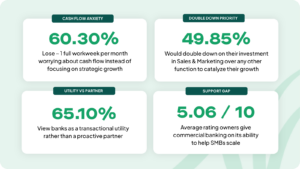
  • Building for Today vs. Tomorrow: While 61.6% of owners operate primarily to sustain their current lifestyle, nearly a third are playing a longer strategic game, building an enduring multi-generational legacy (20.6%) or engineering their business for an eventual acquisition or sale (10.2%).
  • The Commodity Mindset: Owners rate the commercial banking sector a neutral 5.06 out of 10 for its ability to fuel their growth, with 65.1% viewing banks strictly as passive deposit utilities rather than proactive partners (7.2%).
  • Survival Math vs. Strategic Scale: More than half of owners (60.3%) spend roughly one work week every month managing cash flow anxiety rather than business development.
  • Growth Roadblocks: Inflation and rising costs (29.9%) alongside constrained access to working capital (26.2%) represent the two primary external barriers preventing businesses from reaching their next major milestone.
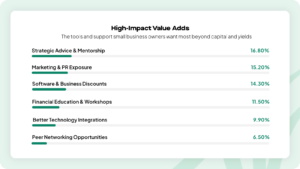
  • Value-Adds Beyond Capital: When asked what non-capital support would make them feel truly backed in their journey, owners prioritized strategic mentorship (16.8%), brand and PR exposure (15.2%), and software discounts (14.3%).

1. The Mental Tax: How Cash Flow Anxiety Drains Executive Focus

While broad macroeconomic metrics often emphasize top-line resilience, day-to-day realities for small business owners tell a far more nuanced story. For many owners, the friction of managing short-term cash flow continuously competes with long-term strategic planning.

To understand this dynamic, we started by examining what owners are actually building toward in the first place. Our survey revealed that 61.6% of small business owners are operating primarily to support their daily lifestyle, while 20.6% are focused on creating an enduring legacy to pass down, and just 10.2% intend to build toward an acquisition or sale.

These numbers illustrate fundamentally different long-term horizons, yet regardless of whether an owner is protecting family livelihood or building an enterprise to outlast them, cash flow remains the universal operational bottleneck:

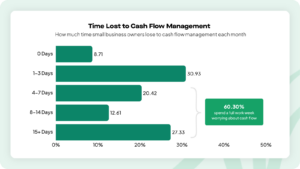
  • 60.3% of small business owners spend roughly 1 full workweek per month worrying about cash flow instead of working on strategic business growth.
  • 27.3% of respondents spend 15 or more days each month in constant “operator mode” wrestling with cash flow concerns.
  • Only 8.7% report having automated, predictable cash flow that requires zero days of monthly anxiety.
This constant state of cash flow triage doesn’t just drain executive focus; it compounds when owners confront the broader economic headwinds standing between their business and its next stage of growth.

The Leading Roadblocks to the Next Milestone

When asked to identify the single greatest barrier standing between their business and its next stage of growth, small business owners pointed overwhelmingly to an acute squeeze between cost inflation and credit access:

  • Inflation & Rising Costs (29.9%): Squeezing operating margins and amplifying cash timing gaps.
  • Access to Capital (26.2%): Constraining inventory, expansion, and seasonal bridge financing.
  • Consumer Spending Volatility (17.9%): Generating demand unpredictability that complicates cash forecasting.
  • High Interest Rates (6.8%): Elevating borrowing costs and limiting leverage.
  • Hiring & Talent Retention (4.9%): Pressuring wage overhead and operational execution.

The Takeaway: Cash Flow Sets the Ceiling on Scale

Taken together, these findings reveal the compounding strain placed on small business leadership. When persistent inflation and fluctuating demand tighten operating margins, access to flexible working capital ceases to be a luxury and becomes the baseline requirement for operational stability.

Yet the ceiling on scale is set not just by how much capital an owner has, but by whether they have the clarity to deploy it strategically when conditions turn. Without reliable forecasting or experienced counsel to lean on, even well-funded companies can stay trapped in reactive mode.

2. The Growth Engine: Where Small Businesses Are Deploying Their Capital

For all the operational friction and reactive management documented across our findings, small business owners are not playing defense by choice. Managing constant cash flow pressure doesn’t reflect an absence of ambition; it reflects a shortage of working capital. When liquidity constraints are cleared and leadership bandwidth is reclaimed, owners do not use that breathing room to maintain the status quo. They pivot decisively to offense.

To uncover where that trapped momentum naturally flows, we examined where small business owners would deploy resources if their working capital foundation were fully stabilized. The data reveals an unmistakable focus on scalability: rather than diffusing capital across incremental operational fixes, ambitious operators concentrate their investments across three core pillars: customer acquisition, team capacity, and technological leverage.

The Double Down Priority

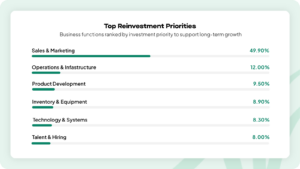
When small business owners have the capital to invest aggressively, their target is overwhelmingly singular: top-line revenue. When asked which single area of their business they would double down on this year to drive meaningful expansion, demand generation easily outranked every other operational priority:

This overwhelming concentration on top-line growth highlights a fundamental truth of modern business building: when operating margins are under pressure, customer acquisition is the strongest buffer against uncertainty. By directing capital straight toward customer acquisition rather than internal overhead, operators are prioritizing the revenue momentum needed to fund every other area of their business.

Next Bold Moves

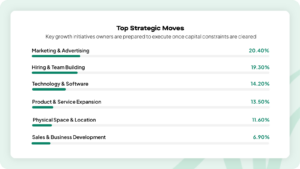
Doubling down on sales and marketing provides the fuel, but scaling a business requires the structural capacity to handle that demand. To understand what this transition looks like in practice, we asked small business owners to identify the single boldest move their company is prepared to execute the moment liquidity constraints are removed.

Rather than speculative bets, their responses reflect a decisive focus on market expansion, team capacity, and modern operational infrastructure:

A small business owner’s boldest move is rarely about chasing uncalculated risk; it is about buying back time and operational freedom. By pairing aggressive customer acquisition (20.4%) with expanded team capacity (19.3%) and modern software systems (14.2%), small business owners are looking to dismantle the capacity constraints that keep them trapped inside day-to-day execution.

The Takeaway: Cash Flow Sets the Ceiling on Scale

While managing cash flow keeps the doors open, survival is never the end goal. When liquidity constraints are cleared, owners do not use that breathing room to protect the status quo; they immediately invest in winning new customers, hiring help, and strengthening their day-to-day operations. 

The primary barrier to business expansion is rarely an absence of ambition; is the operational reality of an owner whose time is consumed by running the company rather than building it.

3. The Support Gap: Why Commercial Banking Fails to Fuel SMB Growth

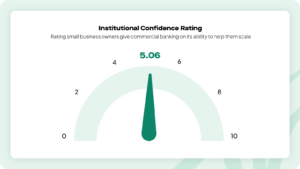
Commercial banking has long prioritized large corporations, leaving small businesses with transactional accounts and rigid systems that do little to fuel growth. When owners were asked to rate how effectively the banking sector actually supports companies of their size, they delivered a telling, neutral verdict:

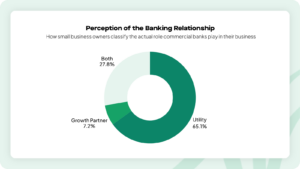
A score of 5 out of 10 indicates that banking is still perceived as largely neutral, functioning as passive financial plumbing rather than a meaningful catalyst for growth. This is further reflected in how small business owners characterize their primary banking relationships:

  • 65.1% of small business owners view banks strictly as a “utility” (a place to hold deposits and clear transactions).
  • Only 7.2% view banks primarily as a growth partner (a proactive source of growth advice and support).
  • 27.8% view banks as both. 

This divide exposes the fundamental limitation of legacy commercial banking: small businesses have outgrown basic transactional accounts. Modern business owners don’t just need a place to park deposits; they need financial systems that actively reduce cash flow friction, streamline back-office workflows, and sustain long-term growth.

The Value-Adds Small Business Owners Actually Want

To uncover how banking can evolve beyond a passive utility, we asked small business owners what non-financial resources would actually move the needle for their operations.

When owners look beyond lines of credit and deposit yields, their priorities reveal an underserved operational reality: leadership is frequently isolated, margin-pressured, and resource-constrained. Rather than generic perks, owners pointed directly toward resources that expand their market presence, reduce operational overhead, and provide experienced strategic perspective:

The distribution of these priorities illustrates three distinct areas where financial institutions have an immediate opportunity to deliver meaningful, day-to-day support:

  1. Strategic Counsel & Advisory (16.8% Mentorship | 11.5% Financial Workshops): More than a quarter of all requests center on high-level guidance. Unlike enterprise corporations equipped with in-house corporate development teams and external boards, small business owners often navigate pricing decisions, risk management, and expansion plans alone. Direct access to experienced mentors and practical financial education gives owners the conviction to make high-stakes calls without second-guessing themselves. 
  2. Customer Acquisition & Brand Amplification (15.2% Marketing & PR Exposure): Nearly one in six owners stated that platform visibility would make them feel genuinely backed. For growing businesses, customer acquisition represents their steepest growth hurdle. When a financial partner leverages its own distribution, amplifying client stories or facilitating partner co-marketing, it delivers tangible commercial upside that far exceeds traditional account services.
  3. Operational Overhead Relief (14.3% Software Discounts | 9.9% Tech Integrations): Growing businesses are running on increasingly complex software-as-a-service (SaaS) stacks for accounting, invoicing, payroll, and point-of-sale (POS). Negotiated partner discounts trim recurring business expenses, while seamless technology integrations ensure that financial data flows effortlessly between the bank and back-office bookkeeping tools, eliminating costly manual reconciliation.

The Takeaway: Transactional Banking Leaves a Support Gap

A 5.06 out of 10 rating confirms that commercial banking is still viewed primarily as passive financial plumbing. But in an environment defined by margin pressure and liquidity friction, neutrality is a liability.

Small businesses have outgrown basic deposit accounts. Moving forward, the value of a financial partner won’t be measured simply by balance sheets and credit limits, but by whether it provides the tools, integrations, and practical guidance owners actually need to drive sustainable, long-term growth.

4. The Executive Trade-Off: Trading Strategic Growth for Daily Admin

Small business owners are frequently overwhelmed by administrative back-office responsibilities. The daily burden of manual bookkeeping, invoice tracking, and repetitive operational tasks quietly diverts high-value leadership hours away from revenue-generating activities.

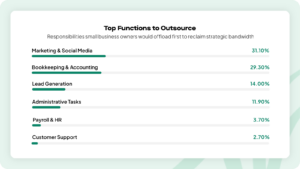
When asked which operational functions they would outsource tomorrow to regain executive focus, owners highlighted an acute appetite for offloading administrative friction:

Combined, 60.4% of all owners would prioritize outsourcing either Marketing or Bookkeeping to reclaim high-value strategic hours.

The True Cost of Administrative Drag

When financial workflows are fragmented across disjointed spreadsheets, legacy banking portals, and manual reconciliation routines, small business owners become the default administrative bottleneck. Bookkeeping and accounting (29.3%) and general admin (11.9%) represent pure operational overhead; essential for compliance, but completely detached from revenue generation.

Small business owners aren’t looking to build out massive internal accounting departments; they are looking for practical financial automation that syncs payment processing, categorizes expenses in real time, and converts fragmented record-keeping into a single, cohesive workflow.

The Takeaway: Administrative Friction Directly Limits Growth

Routine administration is an invisible tax on small business momentum. When business owners spend their working hours reconciling ledger entries and managing back-office paperwork, growth stalls. 

Traditional deposit accounts do nothing to alleviate this drain. Without modern systems to strip away that operational grind, owners will remain trapped working as their own back office instead of leading their companies forward.

5. Navigating Uncertainty: Why Mentorship Matters as Much as Capital

Financial tools and working capital only solve part of the equation. Leading a small business is an inherently isolated endeavor, and owners consistently point to trusted guidance and peer perspective as essential to long-term survival. The data demonstrates that business owners place immense value on experienced counsel, not as a luxury, but as a practical buffer against the costly mistakes that derail a business in its formative years.

Guidance & Strategic Expertise

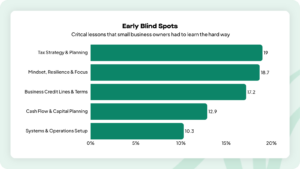
When reflecting on their earliest days, business owners highlighted a sharp divide between the operational advice they needed and the guidance they actually received:

These figures highlight the blind spots that cost owners the most. Rather than generic encouragement, owners reported navigating critical financial structures (like proactive tax planning and establishing commercial credit) entirely by trial and error. 

I wish I had received proactive advice from a bookkeeper/accountant or tax consultant early on, instead of trying to go back and fix things after the fact.
Mattie, Stem Studio

The high ranking of mindset and resilience (18.7%) underscores a fundamental truth: the emotional weight of leadership is tied directly to managing high-stakes financial decisions without a roadmap. When owners lack experienced counsel for foundational structures, every operational hurdle feels amplified. True mentorship doesn’t just offer perspective; it removes the guesswork that exhausts small business owners before they can reach scale.

The Discipline of the Long Game

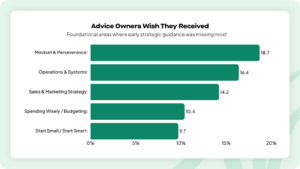
When asked what guidance would have been most valuable when first starting out, small business owners looked past immediate tactics and pointed straight toward mental stamina and strategic discipline:

For many owners, the advice that mattered most came down to managing expectations and protecting their own time:

You are going to be working hard now for future returns — success doesn't happen overnight.
Jamie, Giani Solutions
I need to work ON the business and processes vs. IN the business — that would have helped us scale faster.
Jonathan, The Casita Group LLC

Together, these perspectives reveal that surviving the early years requires balancing mental endurance with operational discipline. Patience alone is rarely enough. Waiting for future returns only pays off when owners actively build the systems that remove them from daily firefighting. The long game isn’t merely about working harder for longer; it is about establishing the practical processes and financial habits that allow a business to grow without consuming the person running it.

The Takeaway: Capital Fuels Growth, but Guidance Sustains It

Access to capital is vital, but lasting stability is ultimately built on proactive planning, sound judgment, and operational resilience. A loan or line of credit can fund inventory and payroll, but it cannot steer through a rough patch. 

When small business owners are left to figure out tax strategy, cash crunches, and credit terms in isolation, even well-funded companies stumble. Looking ahead, a company’s survival will depend less on the size of its credit line and more on whether owners have reliable shoulders to lean on when conditions turn.

Methodology & Demographics

  • Diagnostic Focus: Working capital management, operational bottlenecks, institutional banking satisfaction, and forward-looking growth priorities.
  • Target Population: Verified small-to-medium business owners and founders nationwide across retail, professional services, manufacturing, technology, and consumer goods.
  • Sample Size & Statistical Precision: Based on a nationwide sample of N=314 verified respondents, evaluated at a 95% confidence level with an overall margin of error of 5.5 percentage points.
  • Timing: Fielded Q2 2026
  • Macroeconomic Reference: National GDP contribution and net new job creation data benchmarked from the U.S. Small Business Administration (SBA) Office of Advocacy (2026).

The content provided on this blog is intended for educational and informational purposes only. It is not intended to be, and should not be construed as, financial, investment, tax, or legal advice. We strongly recommend consulting with a qualified financial advisor, tax professional, or legal counsel regarding your specific circumstances before making any financial or tax-related decisions.

Grasshopper Bank

Grasshopper Bank is a client-first, full service digital bank serving the business and innovation economy. Grasshopper Bank replaces the traditional one-size-fits-all approach to banking with a suite of products and services tailored to specific industries and a passionate team of experts with deep expertise in their fields. Grasshopper Bank’s banking solutions cover small businesses, startups, fintech-focused Banking-as-a-Service (BaaS) and commercial API banking platforms, SBA lending, and white-labeled consumer banking. Headquartered in New York, New York, the bank is a member of the Federal Deposit Insurance Corporation and is an Equal Housing/Equal Opportunity Lender.

We don't support Internet Explorer

Please use Chrome, Safari, Firefox, or Edge to view this site.

Privacy Overview

This website uses cookies so that we can provide you with the best user experience possible. Cookie information is stored in your browser and performs functions such as recognising you when you return to our website and helping our team to understand which sections of the website you find most interesting and useful.