The Reality of Modern Small Business
According to the U.S. Small Business Administration Office of Advocacy, small businesses generate nearly half of all U.S. economic activity and create two out of every three net new jobs, yet traditional financial services have long treated commercial banking as a commodity: a passive repository to hold deposits, collect transaction fees, and offer rigid lending terms.
Our 2026 Beyond Small Report benchmarks the unfiltered operational realities of hundreds of small-to-medium business owners across the country, revealing a defining tension in modern commerce: while small business ambition has never been higher, owners and operators are diverting vital time and strategic capital to manage the recurring friction of uneven cash flow, disjointed financial systems, and an institutionally indifferent banking sector.
Diagnosing What Small Businesses Truly Need
To move past surface-level commentary and examine the compounding pressures confronting modern business owners, we launched the Beyond Small diagnostic survey. Designed to give participating business owners a collective voice and peer-tested clarity, this report provides an honest look at the real challenges, priorities, and day-to-day decisions shaping small businesses today.
Core Dimensions
- Growth Barriers: Pinpointing the daily operational and macroeconomic roadblocks holding businesses back.
- Growth Potential: Highlighting where ambitious owners and operators are prepared to deploy capital, expand capacity, and make their boldest moves.
- Support Gaps: Evaluating how effectively current commercial banking services meet the practical needs of small businesses.
Key Findings at a Glance
- Building for Today vs. Tomorrow: While 61.6% of owners operate primarily to sustain their current lifestyle, nearly a third are playing a longer strategic game, building an enduring multi-generational legacy (20.6%) or engineering their business for an eventual acquisition or sale (10.2%).
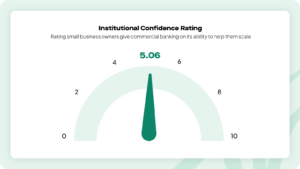
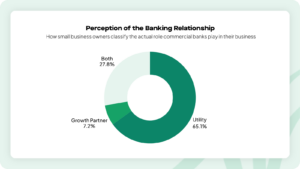
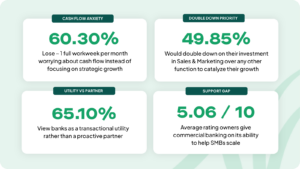
- The Commodity Mindset: Owners rate the commercial banking sector a neutral 5.06 out of 10 for its ability to fuel their growth, with 65.1% viewing banks strictly as passive deposit utilities rather than proactive partners (7.2%).
- Survival Math vs. Strategic Scale: More than half of owners (60.3%) spend roughly one work week every month managing cash flow anxiety rather than business development.
- Growth Roadblocks: Inflation and rising costs (29.9%) alongside constrained access to working capital (26.2%) represent the two primary external barriers preventing businesses from reaching their next major milestone.
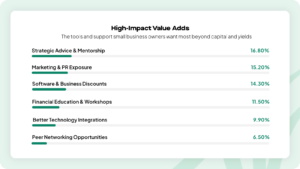
- Value-Adds Beyond Capital: When asked what non-capital support would make them feel truly backed in their journey, owners prioritized strategic mentorship (16.8%), brand and PR exposure (15.2%), and software discounts (14.3%).
1. The Mental Tax: How Cash Flow Anxiety Drains Executive Focus
While broad macroeconomic metrics often emphasize top-line resilience, day-to-day realities for small business owners tell a far more nuanced story. For many owners, the friction of managing short-term cash flow continuously competes with long-term strategic planning.
To understand this dynamic, we started by examining what owners are actually building toward in the first place. Our survey revealed that 61.6% of small business owners are operating primarily to support their daily lifestyle, while 20.6% are focused on creating an enduring legacy to pass down, and just 10.2% intend to build toward an acquisition or sale.
These numbers illustrate fundamentally different long-term horizons, yet regardless of whether an owner is protecting family livelihood or building an enterprise to outlast them, cash flow remains the universal operational bottleneck:
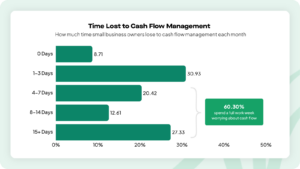
- 60.3% of small business owners spend roughly 1 full workweek per month worrying about cash flow instead of working on strategic business growth.
- 27.3% of respondents spend 15 or more days each month in constant “operator mode” wrestling with cash flow concerns.
- Only 8.7% report having automated, predictable cash flow that requires zero days of monthly anxiety.
This constant state of cash flow triage doesn’t just drain executive focus; it compounds when owners confront the broader economic headwinds standing between their business and its next stage of growth.
The Leading Roadblocks to the Next Milestone
When asked to identify the single greatest barrier standing between their business and its next stage of growth, small business owners pointed overwhelmingly to an acute squeeze between cost inflation and credit access:
- Inflation & Rising Costs (29.9%): Squeezing operating margins and amplifying cash timing gaps.
- Access to Capital (26.2%): Constraining inventory, expansion, and seasonal bridge financing.
- Consumer Spending Volatility (17.9%): Generating demand unpredictability that complicates cash forecasting.
- High Interest Rates (6.8%): Elevating borrowing costs and limiting leverage.
- Hiring & Talent Retention (4.9%): Pressuring wage overhead and operational execution.